Hedgehogs: Characteristics

hh

Size

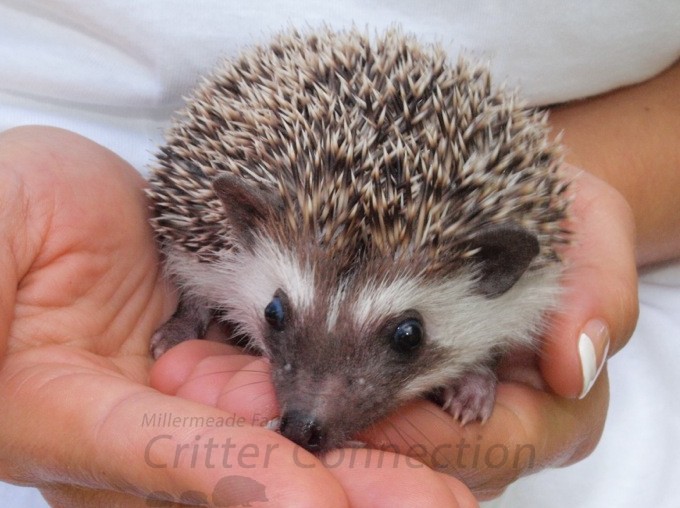
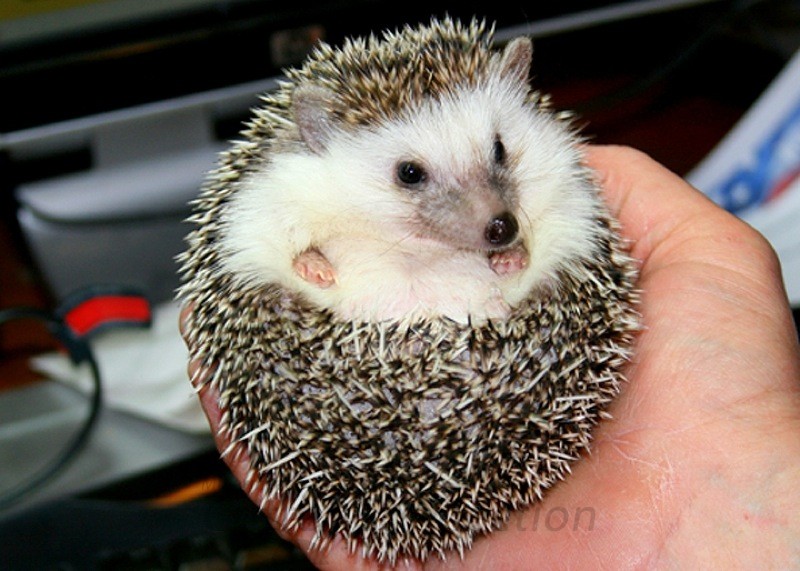
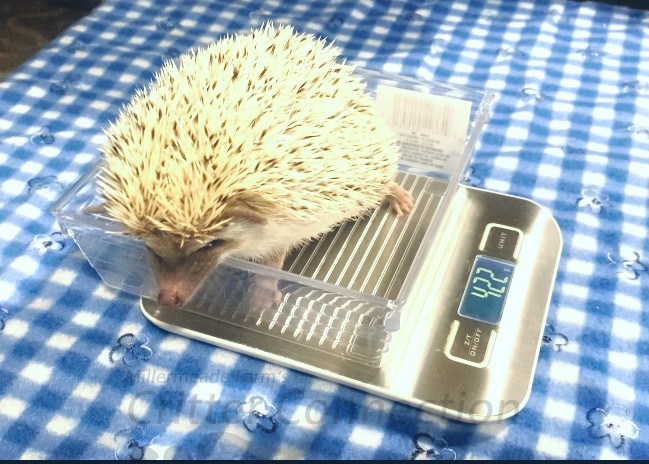
  • The average hedgehog weighs approximately ½ to 1-¼ pounds and most are the size of a softball or slightly larger when they are rolled into a ball.
  • Some adult hedgehogs have a slightly larger build and can weigh up to 2 pounds (the size of a small guinea pig) without being fat.
  • Most hedgehogs are 6-8 inches in length, but it is hard to accurately and consistently measure a hedgehog because their body changes shape when it is balled up, relaxed, sitting or moving.

Spines

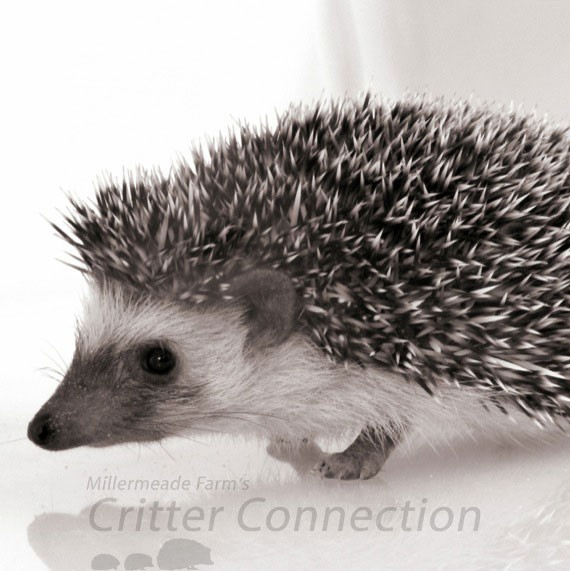
  • The most unique and obvious physical characteristic of hedgehogs is their spines.
  • The weight of the spines accounts for approximately 35% of the hedgehog's weight. (Miller)
  • Technically speaking, hedgehogs have spines and not quills, but their unique hair is often referred to as quills.
  • The hedgehog's spines have solid shafts, whereas quills are hollow like a feather. Also, the hedgehog does NOT release its spines as a form of defense, as a porcupine does its quills.
  • Another contrast between a porcupine's quills is a hedgehog's spines do NOT have barbs on the end that can stick in your skin like a porcupine's quills.
  • Hedgehogs do use their spines as their main line of defense by erecting them so they criss-cross and point in different directions protecting the skin and body.
  • Hedgehogs have an orbicularis muscle that it contracts like a drawstring when it rolls up into a ball.
  • The hedgehog hides its head and legs by creating a ball and using its spines as protection.
  • Hedgehogs can puff of pop, and if you are poked by an individual spine it can be painful.
  • Proper handling techniques allow the hedgehog to become relaxed and handled comfortably.
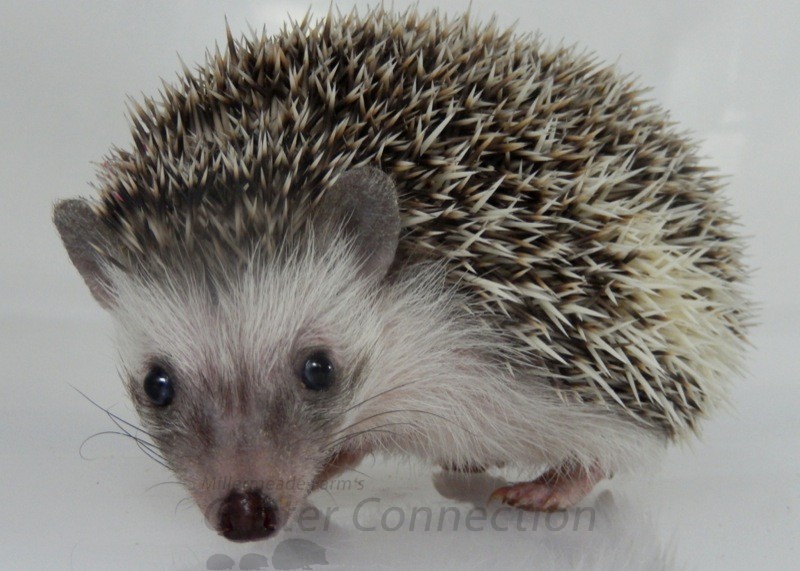
  • Its spines will lay flat toward the tail when relaxed, and the spines will feel relatively smooth when petted from front to back.

Forehead Furrow

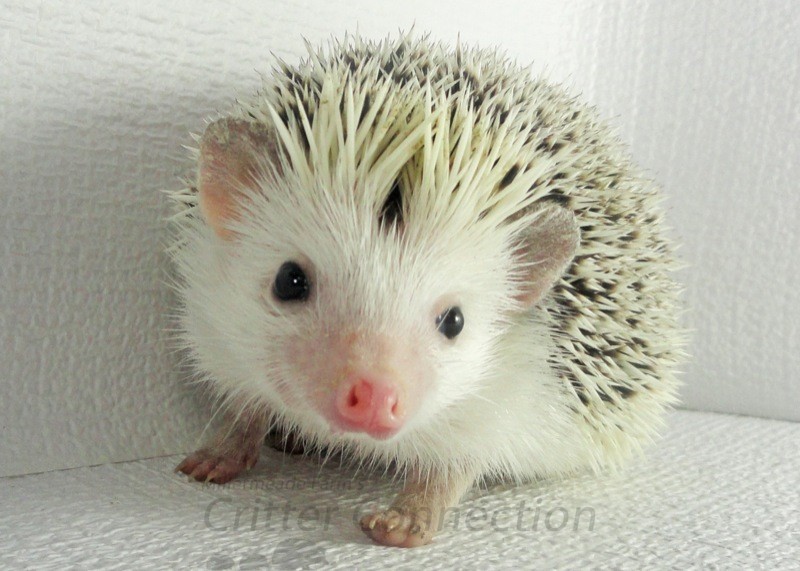
  • There is a natural part in the spines on the forehead of the hedgehog.
  • A hedgehog can raise its forehead spines when it is nervous or mildly irritated. The furrow provides space for the raised spines so they point forward instead of criss-crossing when the skin is pulled down over the eyes.
Characteristitcs

Teeth

  • Hedgehogs have 36-44 teeth in a long, pointy snout.
  • The first pair of incisors is slightly larger than the rest, but they are certainly not as dramatically different in size from their other teeth as a rodent's front teeth.
  • Hedgehog incisors do not continuously grow, as do rodent incisors, and so they do not have an innate need to chew or gnaw on things to wear down their teeth.
  • The baby teeth are shed early and replaced by rooted adult teeth.
  • Poor diet can cause tooth decay and gum disease.

Feet

  • Hedgehogs have 4 toes on the rear feet and 5 toes on the front feet in the Atelerix species.
  • The nails on the front feet may need trimmed more frequently than the rear feet to prevent them from curling into the foot and damaging the footpad.
  • Hedgehogs' feet and toes are made for walking and running.
  • They do not have opposable thumbs or fingers for grasping or vertical climbing.

Tails

  • Both sexes have short, stubby tails that are usually hidden under their quills.
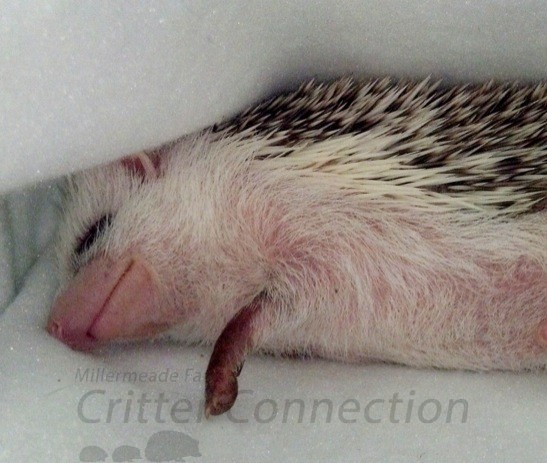
  • The tail can be confused with a penis because the tail curves toward the head when the hedgehog is placed on its back. The male's penile sheath and hidden penis are located mid-abdominally.

Fur

  • Hedgehogs have soft, white fur on their face and bellies.
  • They typically keep their fur clean and neat and a healthy hedgehog should have no mats or caking of its fur.

Chin Mole

  • This small bump under the chin is harmless and normal.
  • It is often referred to as a "cutie mark."

Colors

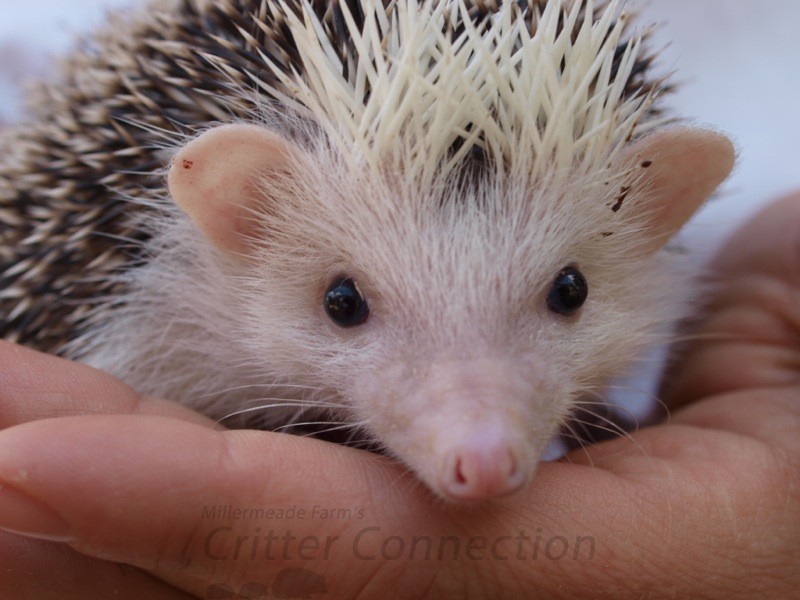
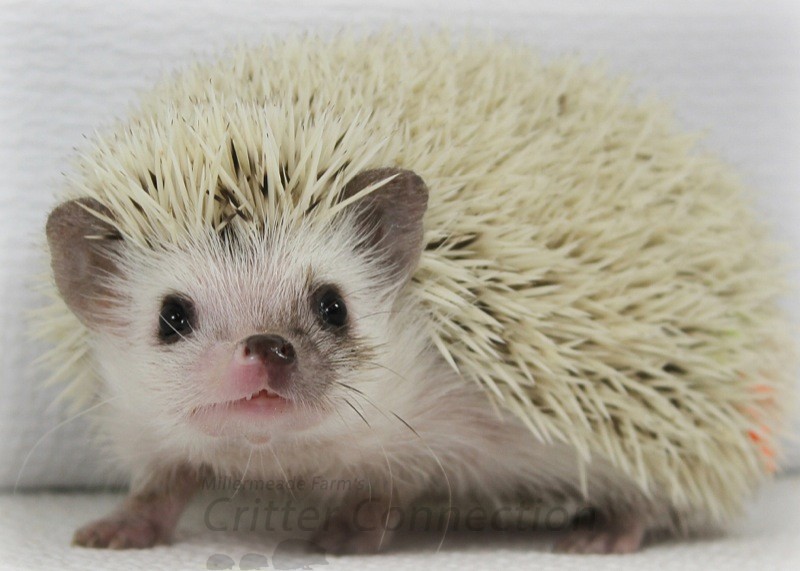
  • The Atelerix species tends to have whitish or light colored faces, whereas the Algerian hedgehog has a darker face. Most hedgehogs pets today are a hybrid of the two species and the very dark Algerian face masks are fairly rare.
  • Hedgehog spines or quills can range in color from an almost black band to a very pale peach color in the banding.
  • The spines may be banded or solid white.
  • Hedgehogs may actually change color variations as they mature and get older. The best age to determine color is approximately one year.
  • The International Hedgehog Association and the Hedgehog Central Web site acknowledge more than 90 different colors of hedgehogs. These colors include various quill colorations, as well as their snowflake and white varieties.
  • Quill, skin, face, nose, and leg coloration all come into play when determining the hedgehog's true color.
  • Many hedgehog enthusiasts simplify the colors by placing hedgehogs in a few many categories such as standard (black to brown variations), cinnacot (tan or light brown variations), black eyed whites (90% or more white quills), albinos, snowflakes (10-89% white quills), and pintos (any color with patches of white quills).

Odor

  • Hedgehogs do not have a scent gland like ferrets and, therefore, do not have a particularly strong body odor.
  • Hedgehog urine does not contain large amounts of ammonia like a rabbit or a guinea pig.
  • Male hedgehog urine is not stronger than female like male rats, mice, or cats.
  • Hedgehogs do defecate and their feces do stink. What a hedgehog eats affects the feces odor. Wet foods and certain brands of foods produce more of an odor than other foods.
  • There are products available (we sell Elimina) that are sprayed on the food or added to the drinking water that help combat odor internally.
  • Cage cleaning and bedding choices are important parts of keeping hedgehog smell to a minimum.

Human Allergic Reactions

  • There is always a possibility that someone can be allergic to hedgehogs.
  • Dander is a common, animal-related allergy for many people. Cat dander is produced when saliva is deposited on the fur during the self-cleaning process. The dander turns into a fine dust. Hedgehogs are typically considered dander free, but they do self anoint, which could be irritating to some people.
  • Many people allergic to small animals are actually allergic to the bedding. Most bedding is dusty, but hedgehogs can be housed on a variety of beddings that may help to eliminate a dust irritation.
  • It is always a good idea to visit a hedgehog prior to purchase if you suspect you are allergic to other animals.
  • It is possible to have red prickle marks on your hands after handling a hedgehog. I, personally, have gotten these prickle marks several times throughout the years, but it certainly isn't a consistent phenomenon.
  • One long-time hedgehog owner shared with me her hypothesis that when hedgehogs are extremely scared, they can emit a toxin that causes a reaction. While this certainly would explain my experiences, I have been unable to find further documentation on the subject, and it is not a topic that regularly comes up with my customers.
  • Another acquaintance told me they had a hedgehog for quite some time when they suddenly developed sensitivity to their pet.
  • No animal is 100% allergy-free!

Senses

  • Hedgehogs, like all other animals, use their senses to gather information from their environment.
  • One must take into consideration how hedgehogs use their senses when handling them and during the socialization and bonding processes.

Sight

  • Hedgehogs have small, beady eyes and a poor sense of sight. This is probably due in part to their burrowing nature.
  • Compared to humans, and even dogs and cats, hedgehogs have limited binocular vision.
  • They have a hard time with depth perception and will often fall from dangerous heights because they simply cannot tell how far they are from the ground.
  • Other hedgehog senses are much stronger and overcompensate for this weakness.

Hearing

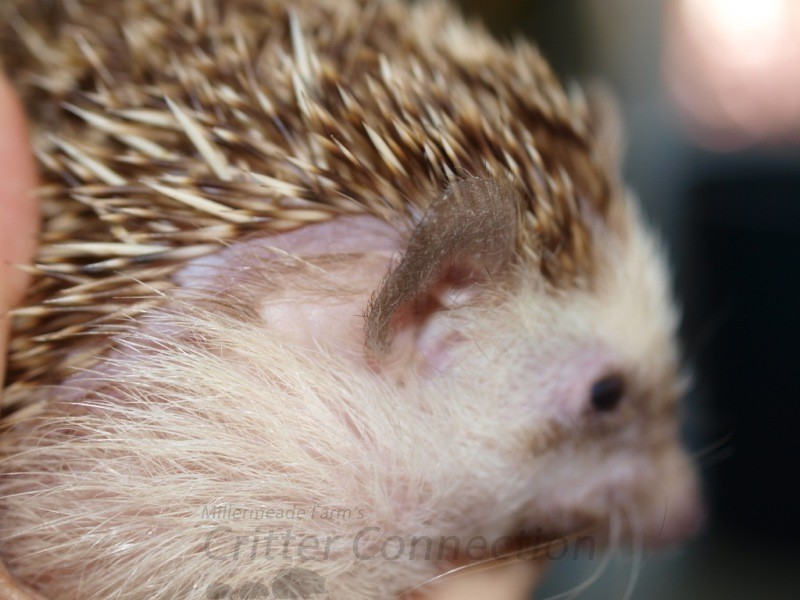
  • Hedgehogs have large ears and have an excellent sense of hearing.
  • Unfamiliar sounds or loud noises can cause hedgehogs to react in defense by huffing and ducking their head in defense.
  • Hedgehogs can become accustomed to a busy household but it may take some time to get used to new surroundings.

Smell

  • Hedgehogs have an excellent sense of smell that is very useful to them in search of food and detecting danger.
  • Their nose is warm and moist and a curious hedgehog will have their snout in the air sniffing in order to gather information from its environment. At the slightest threat of danger (usually detected by noise or movement) they will duck their head for protection.
Characteristics

Motion Detection

  • Hedgehogs are very good at detecting motion around them, even when they are rolled into a ball or cannot see.
  • Hedgehogs will often perceive movement as danger unless they are completely relaxed with their surroundings.
  • A sleeping hedgehog (or a hedgehog trying to go to sleep) may display their annoyance of movement around them even if they know the cause of the movement.
  • For instance, if you are in the dark you can sense movement even if you cannot see what is moving. A good example is a haunted house – you are naturally afraid when something moves close to you, until you can distinguish between the unknown and a friend.
  • They will raise their quills when they sense movement to protect themselves. They are naturally defensive until they are convinced they are safe.
  • It is human nature to want to reach out and touch a hedgehog when it is sleeping or curled into a ball in its cage. What we might consider touching, a hedgie considers a poke, and it will almost always raise its quills with a huff and a puff resulting in a prick to the poking finger.
  • Proper handling can help prevent the automatic fear when being picked up.

Emotion Detection

  • Hedgehogs, like other animals, are able to sense the fear, nervousness, or confidence of the humans handling them.
  • Hedgehogs have a tendency to act more nervous if they sense you are nervous and will relax more quickly if you are calm.

Vocalizations

  • Hedgehogs have a wide range of sounds that they use to communicate.
  • You must listen carefully and observe the hedgehog's behavior to clearly understand what your pet is trying to communicate.
  • Different people can describe each noise that a hedgehog makes in different terms.
  • Some sounds require little or no attention on your part such as the squeaking or chirping of new babies. Other sounds such as clicking or popping should be a clear sign to you that your hedgehog is in defense mode and you need to change how you are handling your pet.
  • Chirping/Squeaking- this sound is often the first indication of new babies.
  • Grunting - may be a sign of contentment.
  • Purring or Whistling – sign of contentment. You know your hedgehog is truly enjoying your company when you hear this sound.
  • Singing- strange sounds that are part of the mating ritual.
  • Huffing, Puffing, Sneezing - a sign of irritation, annoyance, or uncertainty. Hedgehogs might huff and puff, but they will not blow your house down! They are simply trying to tell you to back off and give them some space.
  • Clicking or Popping - these sounds are the aggressive/defensive sounds that are made when a hedgehog is trying to defend itself.
  • Sneezing, Wheezing, Snuffling – certainly these sounds can be a sign of illness but some hedgehogs are simply trying to have a hedgehog "conversation" with you or are simply checking things out.

Squealing

  • You may hear this sound when a fight is about to occur between two hedgehogs.
  • It is a good idea to keep a close eye on the hedgies because injuries can quickly occur during fights.

Screaming

  • This sound is something that you never want to hear. It is a sound of pain or extreme fear.
  • Fighting or accidental injury can be causes for this sound.
  • Hedgehogs have been known to make this noise in their sleep with no apparent cause as if they are having a hedgie nightmare.

Longevity

  • Hedgehogs typically live two to three years in the wild. The most common cause of death in the wild is due to predation rather than age.
  • Hedgehogs can live up to 10 years in captivity, but those hedgehogs are few and far between. A 10-year-old hedgehog would be similar to a 104-year-old grandma.
  • A 5-year-old hedgehog is about 76 in people years, so if your hedgehog lives 5-7 years it has lived a full life but five years is longer than the national average.
  • According to the article "Mortality and Longevity, Update! Boys vs. Girls" found in the September to December International Hedgehog Association Newsletter, "There is no statistical difference in life expectancy between male and female hedgehogs. The average Hedgehog Lifespan is 38.5 months as of July 27, 2005." (Graesser)
  • Several things to consider when looking at longevity are diet, type of bedding, veterinary care, environmental stressors, and genetics.
  • The number one cause of hedgehog death is various forms of cancer.
  • We hope that your hedgehog lives to a ripe old age but, unfortunately, not all pets live as long as others because of the previously mentioned factors. We appreciate feedback from our customers so that we trace bloodlines. It is important for us to know the parents of your hedgehog (from your receipt), as well as the cause of death of your pet if known.

Signs of Good Health

  • Check its eyes to make sure they are bold, clear, round, and bright. The eyes should be wide open. The eyes should not be watery or sunken, dull, or have any discharge.
  • The hedgehog's nose should be moist and clean. It should not be dry, bubbly, or running.
  • Your hedgehog's ears should be clean with no drainage, crustiness, or flaking on the outer part of the ear.
  • Check the skin to make sure there are no abrasions, lumps, bumps, excessive dryness, bare patches, or signs of mites.
Characteristics
  • The underbelly fur should not be matted.
  • The hedgehog's body should be filled out through the back and sides.
    • Some hedgehogs have a streamlined appearance, but their skin should not be loose and they should be filled out below the ribs.
    • Other hedgehogs are plumper but they should not be so fat that they cannot easily roll into a ball.
  • Breathing should be regular with no wheezing or signs of stress. Do not confuse the normal hedgehog huffing for the rattle of a respiratory illness.
  • Notice the amount of food and water consumption from the previous night and has the hedgehog gained or lost a significant amount of weight.
  • The hedgehog's bowl movements should be similar in color to the hedgehog's food. Green droppings or diarrhea are signs of illness and stress.
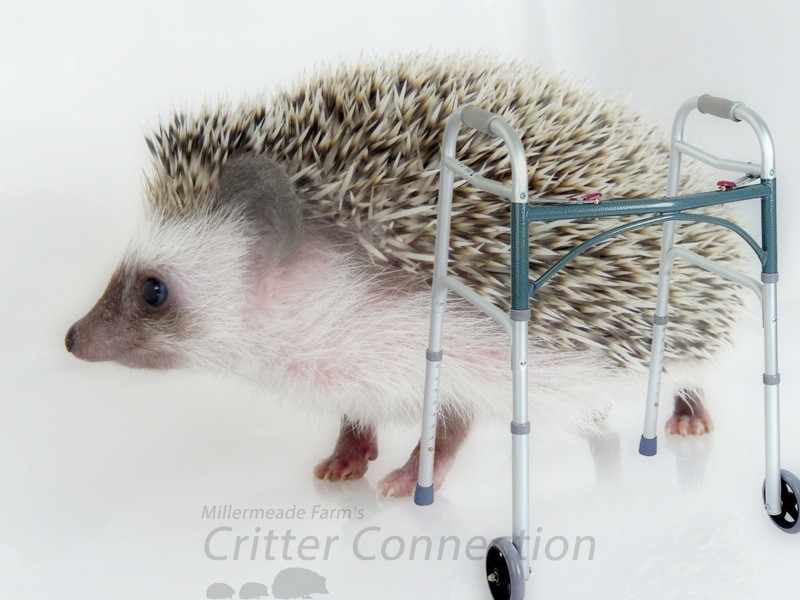
  • Your hedgehog should move freely without limping, wobbling, or dragging its feet. A hedgehog's normal gait will create a "pitter-patter" sound.
  • I encourage NOT buying an animal as a "rescue" to remove it from terrible conditions either from a breeder or a pet store. Purchasing the animal may improve that particular animal's condition, but it will do nothing to prevent future animals from being housed or maintained in similar situations. Instead, kindly and respectfully point out the problem and try to educate the person or store about proper hedgehog care. Some instances of neglect are not from intent but from lack of information. Should the situation not improve it may be necessary to notify the proper authorities. Hedgehog sales are governed by the USDA, which is obligated to investigate all complaints.

Basic Breeding Information

  • Baby hedgehogs are called hoglets.
  • Hedgehogs can produce litter sizes ranging from 1-9, with the average litter size being 3-4.
  • The gestation or the amount of time from conception time until birth is typically 33-35 days.
  • The average recommended breeding age is six months.
hh

Physical Gender Differences

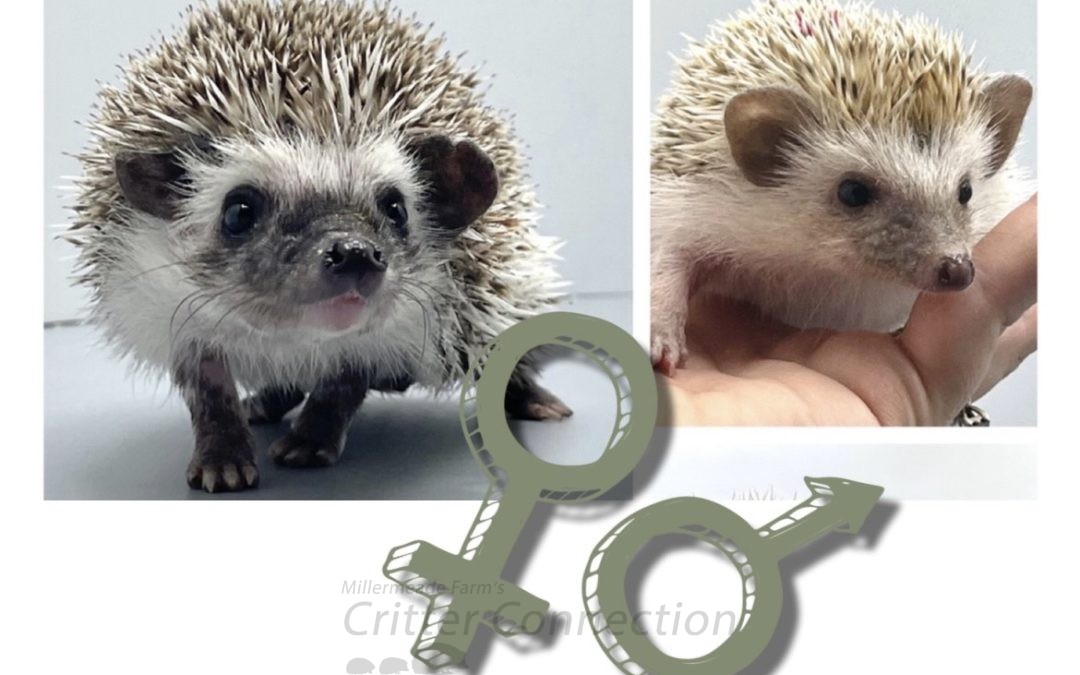
  • Male hedgehogs are called boars. Their penis is retracted within a penile sheath that is located in the mid-abdominal region of the hedgehog. The external portion of the sheath most closely resembles a belly button. The testicles are located in the abdomen and are generally not seen.
Male Hedgehog Gender
  • Female hedgehogs are called sows, and their vulva and anus are very close in proximity to each other. They have five pairs of mammae or teats.
  • Male and female hedgehogs should be housed separately from the time of weaning and should only be allowed contact for breeding purposes.
Female Hedgehog Gender
  • Hedgehogs can breed as early as 8 weeks. Breeding at this age can be very dangerous for the female and is highly discouraged by most breeders.
  • Male hedgehogs can get bedding or other material inside its penile sheath. You will need to check this area daily to make sure there is not blockage or irritation. Most irritations can be freed during a normal bath but if a problem persists then a trip to the veterinarian will be necessary.
  • There are no odor differences between males and females.
  • Neither males nor females scent mark.
  • Females do not have obvious menstrual cycles.

Temperament Gender Differences

  • I, and a majority of hedgehog owners and/or breeders, do not believe there are major temperament differences between males and females.
  • Females cohabitate better than males. We have seen signs that some of our female hedgehogs prefer to have a cage mate, but it is not absolutely necessary in most cases.
  • Males can self-stimulate, but this practice is not typically a complaint of male hedgehog owners.

Cohabitation and Gender Differences

  • It is common knowledge that hedgehogs are solitary creatures in the wild.
  • However, we have found through our own experience, research, and customer feedback that some hedgehogs actually do quite well together.
  • Baby hedgehogs, especially females, cohabite quite well throughout their life.
  • Female hedgehogs have a tendency to cohabitate better than males because they do not have the testosterone and risk of aggression during their sexual prime.
  • Males that are raised together and are never exposed to females may also cohabitate nicely.
  • All cohabitation should be monitored throughout the hedgehog's life and one should be prepared to separate the hedgehogs if signs of dominance develop.
  • Adult males, not raised together, and/or exposed to females have the greatest risk for fighting and are not recommended for cohabitation.
  • We have seen signs that some of our female hedgehogs prefer to have a cage mate, but it is not absolutely necessary in most cases.

Gender Differences and Health Care

Males

  • Male and female hedgehogs obviously have different reproductive and urinary tract systems and their main health care concerns are related to these differences.
  • A male's penis is contained in the penile sheath and is only exposed during urination, breeding, and on occasion self-stimulation.
  • Hedgehogs are relatively low to the ground therefore their extended penis is even closer to the ground. There is a chance that bedding can stick to the extended penis and be drawn up into the penile sheath. One can be certain that this problem is both irritating to the hedgehog as well as a potential for infection or other damage.
  • Good bedding choices and daily monitoring of your hedgehog dramatically reduce the incidence of serious problems.
  • The first sign of irritation is redness and/or swelling. A bath and gentle cleansing of the area may be sufficient treatment.
  • Veterinary care may be required for more serious irritations.

Females

  • A female hedgehog's urinary and reproductive systems and the associated problems appear to be closely related.
  • Again, a female hedgehog is close to the ground which most likely contributes to the potential of urinary and reproductive tract issues.
  • One obvious indication of a urinary tract infection is visible blood in the stool. Change in eating, elimination habits, and general decline in health are also potential signs of a problem.
  • Female hedgehogs are induced ovulators, meaning their reproductive cycle is stimulated by the presence of a male rather than cyclic ovulators like humans.
  • Some hedgehog owners and breeders believe that having a male and female in the same household without breeding the female increases the risk of uterine cancers.
  • On the other hand, breeding drastically increases the risks of problems during pregnancy, birth, and post natal care.
  • Some veterinarians recommend preventative spaying of females. However, there are risks with every invasive procedure and use of anesthesia. Proactive spaying is not yet widespread among owners of female hedgehogs and is not recommended by all veterinarians.
  • At this point in time no studies have been done showing the advantages and disadvantages of preventative spaying. Since veterinarians tend to only see hedgehogs with problems it is hard to get a good idea of what percentage of female hedgehogs in the pet population actually need spaying.
  • Most veterinarians and breeders DO recommend spaying at the first sign of urinary or reproductive issues. It is much easier to treat a small problem than try to fix a larger problem later on.

Conclusion

  • It is our experience that neither males nor females make a better pet.
  • We suggest finding an experienced veterinarian in your area and consulting with them if you have any concerns regarding owning a female. Having a good relationship with a veterinarian is not only beneficial before buying your pet and for routine care, but will be critical when dealing with a pet that needs emergency care.
  • On many occasions we have had customers come for one baby hedgehog and after handling several decide that they would like to go home with two.
  • We typically show them females if a customer does not have a gender preference for this reason.
hh

Socialization Defined

  • All hedgehog pet owners want a well-socialized hedgehog but the term "well socialized" can have different meanings and contexts.
  • Most hedgehog enthusiasts think of a hedgehog that uncurls, relaxes its spines, and generally appears to enjoy handling as a socialized pet.
  • How a hedgehog gets to this point and stays socialized can have many variables.

Hedgehog Nature

  • Hedgehogs are typically naturally shy creatures that tend to fear the unknown.
  • Their poor eyesight but heightened sense of hearing, motion detection, and emotion detection makes them sensitive to how their environment and how they are handled.
  • When a hedgehog is nervous or scared it will ball up and use its spines not as a form of aggression but as a form of protection.
  • You must prove yourself trustworthy before a hedgehog will completely relax with you.
  • More information on this topic can be found in our Behavior & Personality guide.
  • Hedgehogs with health issues may also be less responsive to handling. An uncomfortable or sick animal may rather be left alone. Quilling is an example of a normal process that can be very uncomfortable for a hedgehog and can impact how the hedgehog prefers to be handled.

Owner Responsibility

  • Proper handling is critical to a well-socialized hedgehog and probably the most important factor in whether or not a hedgehog will make a good pet.
  • Hedgehog owners need to learn to understand a hedgehog's subtle ways of communicating and behavior and then respond accordingly.
  • Owners also need to learn:
  • When to handle
  • How to pick up and hold a hedgehog
  • What can cause a hedgehog to be scared or nervous
  • Bonding is also an important part of the socialization process and will occur over time
  • Patience is probably the most important virtue in hedgehog socialization and in a new pet owner.
  • We provide our customers information and tips on this topic in our Care and Handling guides.

Quality Time versus Quantity Time

  • My 10 plus years of experience has led me to believe that the more time spent with an animal does not always equal a better response from an animal.
  • Your actions (quality time) tend to make a larger impact on an animal than the amount of time (quantity time) you spend with that animal.
  • Certainly the amount of time with an animal is important but what you do with the animal during that time is far more important.
  • You can handle a hedgehog the wrong way a long time and get no where in the bonding or socialization process.
  • However, handling your pet the right way and responding to its needs will dramatically speed up the bonding and socialization processes.

Purchasing Socialization

  • Every hedgehog owner wants a friendly, outgoing and well-socialized pet. As previously discussed, socialization greatly depends on how a hedgehog is handled.
  • Proper handling of your hedgehog before it goes home with you plays a role in how your hedgehog will socialize and bond with you at your home. A hedgehog that has been poked and prodded at in a pet store is unlikely to be as good of a pet as one that has been properly handled and cared for by a good breeder.
  • Our Purchasing A Hedgehog guide outlines ways that you can ensure you that you get off to a good start with your new pet.
  • Important purchasing decisions include:
  • Where to purchase
  • What to look for when you buy
  • Selection of a hedgehogs available
  • Choosing a hedgehog
  • Education you will receive at time of purchase
  • Once you have selected and purchased your new pet it is up to YOU to continue the socialization and bonding processes.
  • The Handling and Play guide along with the Care and Acclimation guide we provide our customers are designed to ensure your success.

Most Recent Listed Hedgehogs

HavenFemaleBorn: 2013-04-04 watermark See all available hedgehogs
JaalaFemaleBorn: 2013-04-04 watermark See all available hedgehogs
HadrielMaleBorn: 2013-04-18 watermark See all available hedgehogs

Ohioans- Is your right to own hedgehogs or other small exotics in jeopardy?

Learn More...